
5,925
Reported Suicide Attempts
CY2021–CY2024 · Reported events
Active Component, National Guard, and Reserve. Events, not unique individuals. Coast Guard excluded.
The Formation Accountability Project
It's time Congress hears it.
A nonpartisan military justice research and legislative advocacy initiative dedicated to strengthening accountability, protecting due process, and reinforcing the trust upon which military readiness depends.
Research studyMilitary Leadership, Justice & Institutional Accountability StudyEnter the study →Proposed survey · In development · Participation closedNational Military Leadership & Accountability SurveyView the survey plan →Independent Research & Legislative Advocacy | Proposed 2027 Legislation | Not Introduced
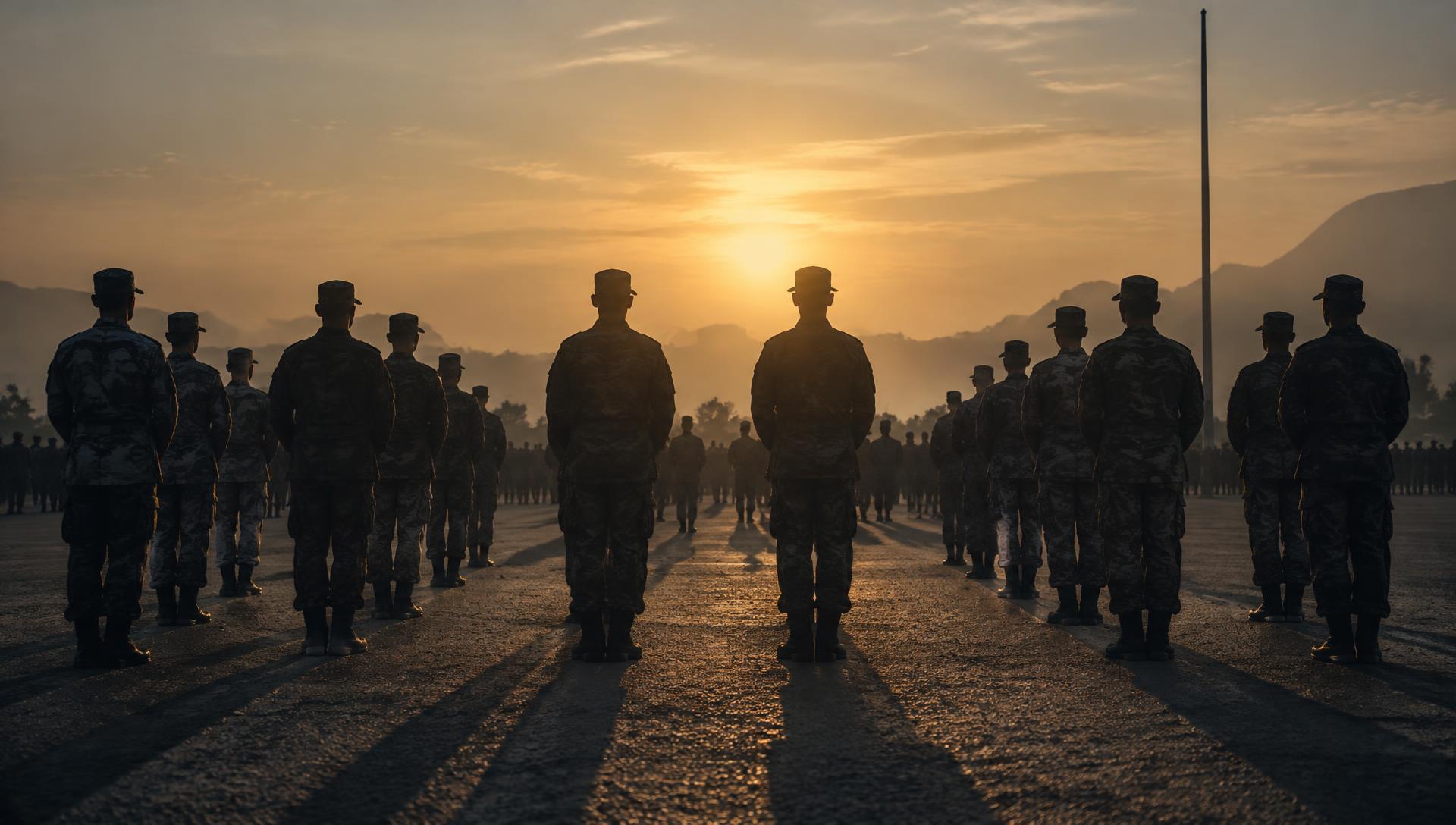
Conceptual military imagery
Official-report figures · CY2021–CY2024
“Behind every number is a service member. Behind every service member is a story that deserves to be heard.”
5,925
CY2021–CY2024 · Reported events
Active Component, National Guard, and Reserve. Events, not unique individuals. Coast Guard excluded.
2,017Official-count total for 2021 through 2024.
CY2021–CY2024 · Total Force
Military suicide deaths across the Active Component, National Guard, and Reserve. Coast Guard excluded.
38 percent
CY2024 · Active Component only
Rounded from 37.8% of reported suicide-attempt forms with this documented association.
23.35 percent
CY2021–CY2024 · Active Component only
Median annual percentage of reported suicide attempts associated with workplace difficulties. Not a causal finding.
“These are not just statistics. They are 2,017 lives lost, 5,925 reported attempts, and thousands of military families confronting the consequences. The Formation Accountability Project seeks answers, independent oversight, and meaningful accountability.”
Reporting period is CY2021–CY2024, not 2021–2026. Attempt and death totals include the Active Component, Reserve, and National Guard and exclude the Coast Guard. Attempt figures are reported DoDSER events, not unique individuals; one person may have more than one reported event.
Workplace statistics cover the Active Component only. The 2024 card rounds the reported 37.8% to 38%. The four-year median uses the annual values 21.1%, 25.6%, 20.2%, and 37.8%: the mean of the two middle values is (21.1 + 25.6) ÷ 2 = 23.35%. Workplace difficulties are documented associations, not established causes.
The death total is the sum of the site’s official annual counts: 519 + 496 + 531 + 471. The CY2023 attempt total uses Tables 9–10 (56 National Guard and 46 Reserve forms); repeated notes in Tables 11–12 contain inconsistent counts and were not used.
Source editions: CY2021 original report; CY2022 and CY2023 official DSPO editions; CY2024 report and DoDSER enclosure. Official source links last checked November 12, 2026.
Beyond the official numbers
“What goes unreported may be just as important as what the numbers reveal.”
Government oversight and peer-reviewed research reveal gaps between military misconduct experiences and formal complaints. Fear of retaliation, concerns about institutional responses, and lack of confidence in reporting mechanisms can discourage service members from coming forward.
Official military misconduct statistics do not necessarily reveal the full scope of mistreatment experienced by service members.
Research identifies associations between military bullying, hazing, institutional betrayal, and psychological distress. Some of these challenges may continue after military separation.
Between 2021 and 2024, the latest Department of Veterans Affairs data series recorded 26,516 veteran suicide deaths. The extent to which earlier military workplace mistreatment contributed to those deaths remains an important unanswered research question.
Explore the evidence, the limitations of existing research, and the questions informing proposed military accountability reforms.
The human cost
Behind every uniform is a human being. Behind every service member is someone who loves them.
Military service asks extraordinary things of ordinary human beings.
It asks them to endure hardship, confront danger, place their trust in others, and carry responsibilities that few outside the formation will ever fully understand.
But the burdens of service are not always visible.
Some service members struggle in silence. Some experience serious misconduct or unlawful retaliation. Some families carry losses that no institution can undo.
The purpose of this project is not to suggest that every hardship is criminal, or that every tragedy can be prevented.
It is to examine whether existing laws, investigative procedures, and accountability mechanisms can be strengthened to better serve those who wear the uniform.
2,017
272,295
$1.0085 Billion
Behind every number is a name. Behind every name is a family, a formation, and a future that will never be the same.
Their service was a promise to our nation. Our responsibility to them does not end with their lives.
For those we have lost.
For those still standing.
For those who will come after us.
The human cost · Research and evidence
And a circle of loss that reaches far beyond the uniform.
| Calendar year | Active | Reserve | Guard | Total | Source edition |
|---|---|---|---|---|---|
| 2021 | 328 | 74 | 117 | 519 | CY21 original edition |
| 2022 | 333 | 65 | 98 | 496 | CY24 revised series |
| 2023 | 363 | 75 | 93 | 531 | CY24 revised series |
| 2024 | 302 | 64 | 105 | 471 | CY24 report |
Active Component, Reserve, and National Guard; no Coast Guard, civilian veterans, or military-family deaths. CY24 Table 1 includes confirmed and suspected suicides as of March 31, 2025, and revises earlier years. CY21 uses its original report edition and requires reconciliation with later revisions. CY2025 remains unconfirmed here. Current-edition verification and five-year reconciliation remain pending.
Cerel, J., et al. (2019). How Many People Are Exposed to Suicide? Not Six. Suicide and Life-Threatening Behavior, 49(2), 529–534. DOI: 10.1111/sltb.12450 · Research abstract
Official source: Defense Suicide Prevention Office annual reports.
Veterans Crisis Line — free, confidential, 24/7
Dial 988, then press 1 · Text 838255. For service members, veterans, and their families.
The Formation Accountability Project is not an emergency response service, mental health provider, official investigative authority, or protected whistleblower disclosure channel.
The proposed solution
Nine interconnected military justice reforms. One commitment to fairness, institutional integrity, and the rule of law.
01 · Climate
Independent screening and investigation of qualifying suicide-related incidents where credible evidence indicates possible misconduct.
Current law
Deaths of service members are subject to investigation, and the Department of Defense conducts suicide prevention, fatality review, and command climate programs.
Proposed amendment
Independent screening of qualifying suicide-related incidents.
02 · OSTC
Expanding independent prosecutorial authority to additional designated offenses.
Current law
10 U.S.C. § 824a establishes special trial counsel with exclusive authority over 'covered offenses', including many sexual offenses, domestic violence, murder, kidnapping, and retaliation.
Proposed amendment
Add all Article 93 offenses to OSTC coverage.
03 · MCIO
A mandatory investigative framework for qualifying allegations involving Army CID, NCIS, Air Force OSI, and other competent organizations.
Current law
Military criminal investigative organizations (MCIOs) investigate many serious offenses, but lower-level allegations may be handled through command-directed inquiries.
Proposed amendment
Mandatory MCIO assessment of credible allegations of designated offenses.
04 · Art. 93
Proposed expansion of Article 93 to address aggravated abusive leadership and qualifying peer-on-peer maltreatment.
Current law
Article 93, UCMJ (10 U.S.C. § 893) prohibits cruelty toward, or oppression or maltreatment of, any person subject to the orders of the accused.
Proposed amendment
Explicit aggravated abusive leadership provisions.
05 · Art. 132
Strengthening criminal and administrative protections for service members who make protected communications or participate in investigations.
Current law
Article 132, UCMJ (10 U.S.C. § 932) criminalizes retaliation, including wrongfully taking or threatening adverse personnel action with intent to retaliate for protected communications.
Proposed amendment
Strengthened protection for qualifying communications.
06 · Art. 107
A proposed aggravated falsification subsection for knowingly false official records that cause substantial material harm.
Current law
Article 107, UCMJ (10 U.S.C. § 907) prohibits false official statements and signing false official records with intent to deceive.
Proposed amendment
An aggravated subsection for knowing and intentional falsification of materially false official records.
07 · Oversight
Privacy-protective reporting and operational review of the proposed investigative and prosecutorial framework.
Current law
Congress exercises legislative and oversight authority; existing DoD reporting, privacy, and investigative confidentiality requirements remain applicable.
Proposed amendment
Aggregated reporting on referrals, screening, investigations, and disposition.
08 · Trafficking
A proposed dedicated UCMJ trafficking offense, coordinated with existing federal trafficking law.
Current law
Federal law prohibits forced labor (18 U.S.C. § 1589), trafficking with respect to peonage, slavery, involuntary servitude, or forced labor (§ 1590), sex trafficking (§ 1591), and attempts and conspiracies (§ 1594).
Proposed amendment
A dedicated UCMJ trafficking offense.
09 · Art. 52
Requiring unanimous findings of guilt by court-martial panels.
Current law
Article 52, UCMJ (10 U.S.C. § 852) generally requires the concurrence of three-fourths of panel members for findings of guilty in noncapital cases.
Proposed amendment
A unanimity requirement for all findings of guilt.
Somewhere, a family is learning to live with an empty place at the table.
Somewhere, a Soldier is carrying a burden that no one else in the formation can see.
And somewhere, a leader is making a decision that may affect another person's life long after the uniform comes off.
The Formation Accountability Project exists because the people entrusted to defend this nation deserve institutions committed to integrity, fairness, and accountability.
Its founder, Deven Wallace, served with the United States Army's 101st Airborne Division (Air Assault), 3rd Brigade Combat Team — Rakkasans.
His experiences helped shape the conviction that military leadership carries responsibilities extending beyond rank, authority, and mission accomplishment.
But this initiative is not about one Soldier.
It is about the people who serve, the families who love them, and the institutions entrusted with their lives.
The measure of this project will never be the recognition of its founder.
It will be the value of the work it contributes.
Review the legislative discussion drafts, the section-by-section proposal, and open research questions. Professional participation is voluntary; contact and participation forms remain non-submitting previews until safeguards and spam controls are approved.
Military service is built upon trust.
Trust in those who lead. Trust in those who stand beside us.
And trust that the institution will remain committed to the principles it asks its people to defend.
The Formation Accountability Project exists to examine how those commitments can be strengthened through law, research, and responsible reform.
Not to presume wrongdoing. Not to diminish lawful military authority.
But to ensure that credible allegations receive fair consideration, proven misconduct receives appropriate accountability, and the people who serve are treated with dignity.
This mission belongs to more than one person.
It belongs to everyone who believes military justice must be worthy of the people it serves.
For those we have lost.
For those still standing.
For those who will come after us.
It's time Congress hears it.
Join the mission