Opening testimony…
Opening testimony…
Deven Wallace · A different way to serve
The Uniform Comes Off. The Oath Remains.
Leaving the formation. Carrying its lessons forward. Continuing the commitment to those who serve.
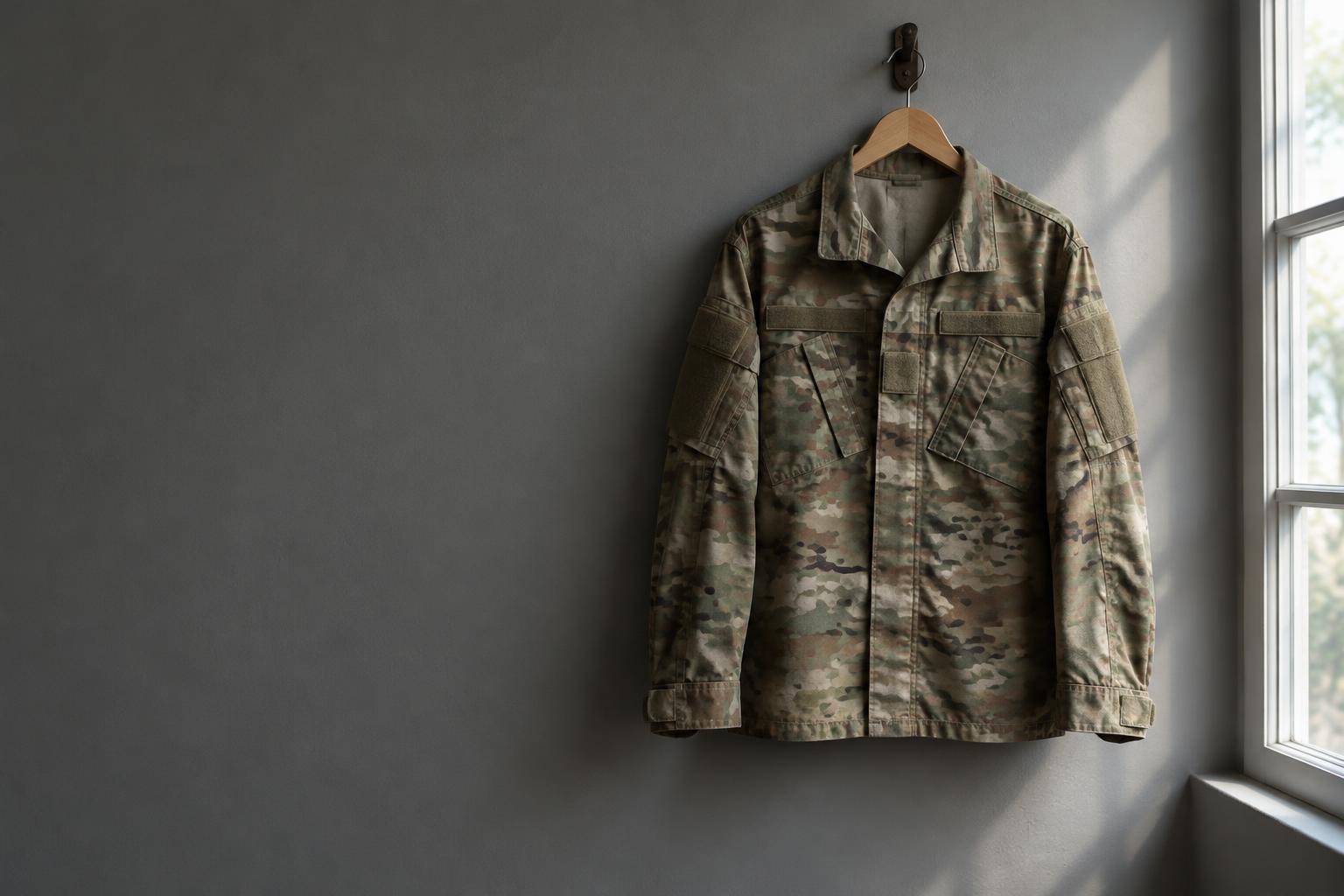
A different way to serveConceptual imagery · Not the founder's actual uniform
Content note: this personal account discusses suicide and loss without graphic details.
Veterans Crisis Line — free, confidential, 24/7
Dial 988, then press 1 · Text 838255. For service members, veterans, and their families.
The Formation Accountability Project is not an emergency response service, mental health provider, official investigative authority, or protected whistleblower disclosure channel.
Chapter 01
There are moments in military service that never leave you.
Moments that follow you long after the formation has been dismissed, the mission has ended, and the uniform has been taken off.
For me, one of those moments began like an ordinary morning in the United States Army.
I had just completed a four-mile run for physical training. I was making my way up the hill near the Air Assault School when I came upon a scene that stopped me.
Military Police squad cars.
Coroner's vehicles.
Army Criminal Investigation Division personnel.
Ambulances.
All gathered outside a barracks building.
I knew something was terribly wrong.
Another Soldier had died by suicide.
Another life lost.
Another family whose world would never be the same.
And another moment that forced me to confront a question I could no longer ignore:
How many more service members must we lose before we are willing to examine not only the individual circumstances surrounding these tragedies, but also the military systems responsible for protecting, leading, and caring for our people?
I cannot tell you what led that Soldier to take their life.
I cannot tell you what was happening behind the closed doors of that barracks room.
And I will not pretend that suicide can be explained by a single event, a single leader, or a single institutional failure.
But I can tell you what that morning did to me.
It stayed with me.
It became part of a growing realization that something needed to change.
During my military service, I personally became aware of more than three dozen deaths by suicide involving service members.
I remember thinking about the lives behind those numbers.
The people.
The families.
The friendships.
The futures that would never unfold.
And I began asking myself whether we were doing enough to learn from these losses.
Not simply to document them.
Not simply to respond to them.
But to learn from them.
Because when a Soldier dies, the responsibility of an institution entrusted with human lives should not end with the conclusion of an administrative process or the lowering of a flag.
We owe those who serve a willingness to ask difficult questions.
And we owe those we have lost the dignity of a serious, compassionate, and evidence-based examination of what can be learned.
Chapter 02
I served in the United States Army, including with the 101st Airborne Division and the Rakkasans.
I have known the pride of wearing the uniform.
I have experienced the discipline, camaraderie, responsibility, and sense of purpose that military service can provide.
I have served alongside extraordinary Soldiers whose character, professionalism, and commitment to one another represent the very best of the United States Armed Forces.
But I have also lived and operated within a military system in which I believe serious accountability problems can exist.
I have witnessed leadership practices that raised troubling questions about the treatment of Soldiers, the exercise of authority, and the effectiveness of existing safeguards.
I have seen how the power imbalance between leaders and subordinates can make reporting misconduct difficult.
I have come to understand how an official evaluation, administrative action, or investigative process can profoundly affect a Soldier's future.
And I have learned that a system can possess extensive regulations, reporting channels, and written protections while still leaving some Soldiers questioning whether those protections will work when they need them most.
The existence of a regulation does not guarantee its effective enforcement.
The existence of a reporting channel does not automatically create confidence in using it.
And the existence of command authority does not establish that the authority has been exercised wisely.
I believe the military must be willing to confront those distinctions.
I understand why the military requires a chain of command.
I understand the necessity of lawful orders, demanding training, discipline, and decisive leadership.
An Army cannot function without them.
But there is a difference between demanding excellence and degrading a human being.
There is a difference between lawful corrective action and unlawful retaliation.
There is a difference between a difficult leadership decision and an abuse of authority.
And there is a difference between respecting the chain of command and believing that rank should shield someone from independent scrutiny.
I do not believe that strengthening accountability weakens commanders.
I believe it strengthens the legitimacy of command.
A Soldier should be able to report serious misconduct without fearing unlawful retaliation.
A Soldier's career should not be harmed by an intentionally falsified official record.
Credible allegations of serious maltreatment should receive independent and impartial investigative consideration.
And criminal prosecutorial decisions involving designated serious offenses should be insulated from improper command influence.
These principles should coexist with fair procedures, the presumption of innocence, and the rights of every accused service member.
Accountability without due process is not justice.
But authority without accountability is not leadership.
Chapter 03
“A formation may appear ready on paper while suffering from serious deficiencies in trust, morale, and confidence.”
Conceptual leadership model — not a quantified causal finding.
Of all the concerns I have described, perhaps the most consequential is the erosion of trust between Soldiers and their leaders.
I firmly believe that effective military leadership requires more than rank, positional authority, technical competence, or the ability to enforce regulations.
It requires the trust and confidence of the Soldiers entrusted to one's command.
The enemy does not care about our feelings, personal disagreements, professional grievances, or internal organizational dysfunction.
Bullets do not discriminate.
In combat, bullets kill.
When American Soldiers are ordered into harm's way, they must possess confidence that the leaders directing them are competent, disciplined, accountable, and genuinely committed to their welfare.
They must believe those leaders can make sound decisions under pressure, accomplish the mission, close with and destroy the enemy when required, and make every reasonable effort to bring their Soldiers home to their loved ones.
That confidence cannot be manufactured through rank insignia, command authority, or mandatory formations.
It must be earned through consistent conduct.
A leader who humiliates Soldiers, dismisses mental health crises, threatens administrative punishment, fails to provide mentorship, or appears unwilling to uphold the same standards expected of subordinates may secure compliance.
But compliance is not the same as trust.
And obedience, while essential to military discipline, cannot substitute for confidence in a leader's judgment when lives are at stake.
My experiences have not instilled that confidence in me.
That realization is one of the most troubling aspects of my decision to leave the Army.
My concern extends beyond my own career or personal experiences.
I am concerned about the Soldiers who remain under leaders whose conduct may have undermined their confidence.
Should the day come when those Soldiers are called upon to engage an enemy in combat, I sincerely hope they will be led by individuals who have earned their trust through competence, integrity, sound judgment, and genuine care for their welfare.
Combat readiness is not measured solely by physical fitness scores, weapons qualifications, equipment readiness, or the completion of mandatory training.
It also depends upon the strength of the relationships between leaders and their Soldiers.
A formation may appear ready on paper while suffering from serious deficiencies in trust, morale, and confidence.
Those deficiencies can become consequential when a unit is placed under the extraordinary pressures of combat.
I believe a leader who cannot earn the trust of Soldiers in garrison should seriously reflect upon whether those Soldiers will have confidence in that leader when their lives depend upon the decisions being made.
And I believe the institution itself must take that question seriously.
Because trust is not a luxury in the profession of arms.
Trust is a component of combat readiness.
Chapter 04
That morning outside the barracks remains with me because it represents something much larger than a single moment in my military career.
It represents the questions I believe we must be courageous enough to ask.
When a service member dies by suicide, what do we examine?
Who examines it?
How independent is that examination?
How do we identify credible allegations of maltreatment, retaliation, coercion, or other misconduct when they are relevant?
How do we ensure that Soldiers can provide information without fear of unlawful reprisal?
How do we protect grieving families while responsibly investigating the circumstances of a death?
And how do we translate what is learned into meaningful prevention and institutional improvement?
The military already has suicide prevention programs, investigative procedures, medical systems, and command responsibilities.
My proposal is not to pretend those mechanisms do not exist.
It is to examine whether additional statutory safeguards could make them more independent, coordinated, transparent, and effective.
I believe qualifying suicide-related incidents should receive structured screening for relevant institutional concerns.
Where credible evidence of criminal misconduct exists, that evidence should be referred for independent criminal investigation.
Where criminal misconduct is not established, the military should still be capable of identifying organizational lessons, leadership concerns, and opportunities for prevention.
A death by suicide must never automatically be treated as proof that someone committed a crime.
But neither should the absence of an established crime prevent responsible institutional learning.
We cannot bring back those we have lost.
But we can ask whether the systems entrusted with the living are learning everything they reasonably can.
And that is a responsibility worth pursuing.
Apply defined proposed screening triggers; a death or attempt is not proof of misconduct.
Preserve evidence and consider relevant institutional concerns through independent review.
Provide voluntary opportunities to share information, with privacy safeguards and protection from unlawful reprisal.
Refer for independent MCIO investigation. Designated offenses receive legally authorized independent prosecutorial consideration, with due process and the presumption of innocence.
Continue organizational learning, identify leadership concerns and prevention opportunities. The absence of an established crime does not end institutional learning.
Prevention, institutional improvement, and proposed oversight reporting
Criminal indicators and organizational concerns are separate screening questions. Either, both, or neither may warrant further review; a command climate assessment is not automatically a criminal investigation.
Explore the full parallel-review framework and legal safeguards →Suicide is multifactorial. The proposed pathway does not attribute a particular death to leadership misconduct.
Veterans Crisis Line — free, confidential, 24/7
Dial 988, then press 1 · Text 838255. For service members, veterans, and their families.
The Formation Accountability Project is not an emergency response service, mental health provider, official investigative authority, or protected whistleblower disclosure channel.
Leaving the Army does not mean abandoning those who remain.
Conceptual imagery
Chapter 05
There will come a day when I take off my uniform for the last time.
I will remove the patches.
Unlace my boots.
And hang up the uniform that has represented years of my life.
That moment will mean more to me than the end of a military obligation.
It will mark the conclusion of a chapter that shaped my character, tested my convictions, and taught me lessons I will carry for the rest of my life.
Some of those lessons came from exceptional leaders who demonstrated what service and leadership should look like.
Others came from experiences that made me question whether our institutions were living up to the standards they demand of the people within them.
I will carry both.
And I intend to do something meaningful with what I have learned.
My decision to leave the Army does not mean I have stopped believing in the Soldiers who serve.
It does not mean I have abandoned the values of duty, integrity, courage, or selfless service.
And it does not mean I have given up on the institution.
It means I have chosen a different way to serve it.
Chapter 06
In Fall 2027, I hope to begin law school.
Over the following three years, I intend to dedicate a substantial part of my legal education to researching, drafting, and advocating for meaningful military justice reform.
Through The Formation Accountability Project, I plan to examine the Uniform Code of Military Justice, military investigative processes, whistleblower protections, command accountability, human trafficking enforcement, suicide-related investigations, and the procedural rights of service members.
I hope to work with legal scholars, military justice practitioners, veterans, service members, military families, and members and staff of the House and Senate Armed Services Committees.
My objective is to develop proposals that can withstand serious legal scrutiny.
Not slogans.
Not political theater.
Not legislation driven by anger alone.
But carefully researched, constitutionally sound, operationally informed proposals capable of improving the institutions that govern the lives of American service members.
The goal is to transform experience into research.
Research into legislative language.
And legislative language into meaningful consideration by those empowered to change federal law.
I know that a three-year project cannot guarantee congressional action.
I know that passing legislation requires much more than identifying a problem.
But meaningful reform begins when someone is willing to do the work.
To ask the questions.
To examine the law.
To listen to those affected.
To accept criticism.
To revise the proposal.
And to continue advocating even when progress is difficult.
That is the work I intend to undertake.
I think about the Soldiers who will continue serving long after I leave.
The young private arriving at a first duty station.
The specialist who is afraid to report misconduct.
The sergeant trying to protect a struggling Soldier.
The commander who genuinely wants to lead with integrity.
The family waiting for someone to come home.
And the service members whose lives ended before they had the opportunity to see what their futures might have held.
They are why this work matters to me.
Not because I believe every leader is failing.
Not because I believe every military institution is broken.
But because I believe an institution entrusted with the lives of America's sons and daughters must remain willing to confront its shortcomings and improve.
The standard should never be whether a system is comfortable with scrutiny.
The standard should be whether that scrutiny helps it become more just, more effective, and more worthy of the trust placed in it.
When I hang up my uniform, I will no longer stand in the same formation.
But I will not forget the people who stood beside me.
I will not forget that morning outside the barracks.
I will not forget the questions that followed.
And I will not abandon the belief that accountability, compassion, and strong military leadership belong together.
I may be leaving the formation.
But I am not leaving the mission.
The uniform comes off.
The oath remains.
And the commitment to those who serve continues.
The planned 2027–2030 mission
Planned phase 1
Build the legal and evidentiary foundation.
The human cost · Research and evidence
And a circle of loss that reaches far beyond the uniform.
| Calendar year | Active | Reserve | Guard | Total | Source edition |
|---|---|---|---|---|---|
| 2021 | 328 | 74 | 117 | 519 | CY21 original edition |
| 2022 | 333 | 65 | 98 | 496 | CY24 revised series |
| 2023 | 363 | 75 | 93 | 531 | CY24 revised series |
| 2024 | 302 | 64 | 105 | 471 | CY24 report |
Active Component, Reserve, and National Guard; no Coast Guard, civilian veterans, or military-family deaths. CY24 Table 1 includes confirmed and suspected suicides as of March 31, 2025, and revises earlier years. CY21 uses its original report edition and requires reconciliation with later revisions. CY2025 remains unconfirmed here. Current-edition verification and five-year reconciliation remain pending.
Cerel, J., et al. (2019). How Many People Are Exposed to Suicide? Not Six. Suicide and Life-Threatening Behavior, 49(2), 529–534. DOI: 10.1111/sltb.12450 · Research abstract
Official source: Defense Suicide Prevention Office annual reports.

The battle here at home
It begins with how we care for one another.
And accountability is everyone's responsibility.
Across our Armed Forces, service members train to confront threats to our nation.
They prepare for deployment.
They learn to operate under pressure.
They rehearse how to respond when lives depend on the decisions made around them.
But there is another challenge that demands our attention.
It exists in barracks rooms.
In military households.
In units struggling with trust.
In the quiet moments when a service member feels unable to ask for help.
And in the lives of families forever changed by suicide.
This is not a battle against our own service members.
It is a shared responsibility to confront suicide risk, strengthen human connection, improve leadership practices, and examine the systems entrusted with military personnel.
Every death is a life lost.
Every life has a name.
And every name belongs to a story that deserves dignity.
When we discuss thousands of deaths, we must remember that those numbers represent people whose absence extends into families, friendships, military units, and communities.
The effects do not stop at the barracks door.
They travel home.
They remain at family dinner tables.
They are felt at graduations, weddings, birthdays, holidays, and milestones that a loved one will never attend.
We cannot reduce that loss to a statistic.
But we can use responsible research to understand its reach.
And we can ask what more our institutions can do.
Veterans Crisis Line — free, confidential, 24/7
Dial 988, then press 1 · Text 838255. For service members, veterans, and their families.
The Formation Accountability Project is not an emergency response service, mental health provider, official investigative authority, or protected whistleblower disclosure channel.
This project is not a crisis intervention service. In immediate danger, call 911 or your local emergency number. Military OneSource offers official non-crisis support.
And it extends through every level of command
The first-line leader may be the person who notices that a Soldier has stopped showing up to breakfast.
The team leader who sees that someone is withdrawing.
The squad leader who notices a change in behavior.
The platoon sergeant who recognizes that a service member is carrying more than they have said.
The commander who creates an environment where asking for help is treated as a sign of responsibility rather than weakness.
Leadership does not make anyone capable of predicting every suicide.
And no leader can eliminate every risk.
But leaders influence the conditions in which service members live, train, work, seek support, and report concerns.
That responsibility begins at the lowest level of leadership and extends through the entire chain of command.
It includes listening.
It includes recognizing changes and concerns.
It includes connecting people with qualified support.
It includes maintaining dignity during disciplinary and administrative processes.
It includes responding seriously to allegations of abuse or retaliation.
And it includes recognizing when a situation requires expertise beyond the chain of command.
Good leadership does not replace professional mental health care.
But it can help create an environment where seeking that care is supported.
Command teams cannot promise that every tragedy will be prevented.
They can be expected to take prevention, response, and institutional learning seriously.
A leader's responsibility does not end with the mission.
It includes the people entrusted to accomplish it.
Shared responsibility
Level 1 of 5
Responsibility is shared across the institution. This is a responsibility framework, not a causal model, automatic referral sequence, or finding that every suicide results from a failure at one of these levels. Leaders do not replace qualified mental health care.
The founder's experience
Proposed legislation · Not enacted
The proposed legislation is intended to complement existing suicide prevention programs—not replace professional care or existing support services.
Structured review of qualifying suicide-related incidents.
Examination of relevant leadership and organizational circumstances.
Safeguards for service members who lawfully provide information.
Appropriate investigation where credible evidence of criminal misconduct exists.
Privacy-protective reporting and evaluation of institutional lessons.
For the formation that continues
It includes the people who served before us.
The families waiting at home.
The leaders who still have the opportunity to make a difference.
The veterans who carry lessons from years of service.
And the people who are no longer here to tell their own stories.
We cannot undo their loss.
We cannot promise that legislation alone will prevent another tragedy.
But we can examine the law.
We can listen to service members and families.
We can support responsible research.
We can strengthen accountability.
We can improve the way institutions learn.
And we can recognize that the obligation to care for those who serve does not end when the uniform comes off.
There is work to be done here at home.
Work that begins with human dignity.
Work that demands responsible leadership.
Work that requires evidence, expertise, and the courage to examine difficult questions.
And work that can continue through the next generation of service.
For those we have lost.
For those who still serve.
For those who will come after us.
The formation has a voice.
It's time Congress hears it.
There is a battle here at home.
It begins with how we care for one another.
And accountability is everyone's responsibility.
THE FORMATION HAS A VOICE.
IT'S TIME CONGRESS HEARD IT.
THE MISSION DOESN'T END WHEN THE UNIFORM COMES OFF.